


24 Aug 2026
How to Build a Scalable Business Model from Day

This year marks a significant milestone for our organization: 35 years of partnering with healthcare systems to support their strategic, real estate, and project management needs in pursuit of growth. Over the past 35 years, we have managed more than 84 million square feet of complex new, expansion, renovation, replacement, ambulatory care, and acute care projects. While every project and client experience is unique, common themes consistently emerge:
Every project involves assembling a team of experts: designers, engineers, construction professionals, and project managers. Yet in focusing on these critical roles, organizations often overlook one of the most important drivers of success:
Good governance.
In our experience, large healthcare capital projects rarely struggle because of design capability or construction expertise. More often, projects lose momentum because decision-making is unclear, inconsistent, or too slow.
When governance is not clearly established:
The greatest risk is inconsistency. Design and construction teams rely on the Owner organization to make timely decisions. Without a defined governance structure—or an accountable executive with the authority to make decisions—issues can move through inefficient approval processes that delay the project and create confusion across the team.
On large-scale healthcare projects, governance is not administrative overhead. It is the operating structure that enables decision-making, accountability, and execution.
With years of experience across projects, we’ve found that what is often underestimated is “project administration”—the foundational structure that places the Owner at the center of the project team.
Many projects do not formally begin until the architect is engaged, and there is often heavy reliance on consultants to determine how the team collaborates. Project managers are expected to “foster collaboration,” but this overlooks a key reality:
Collaboration and effective decision-making do not happen by chance—they must be intentionally designed. They begin with the Owner’s governance structure.
A well-defined governance model establishes:
Effective governance must also define how project decisions flow across:
This includes governance related to:
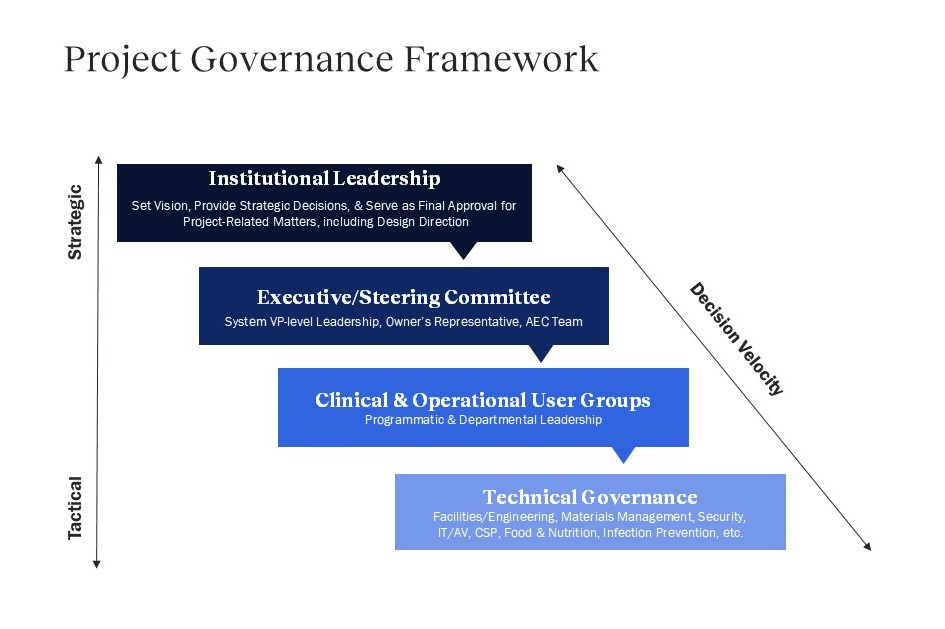
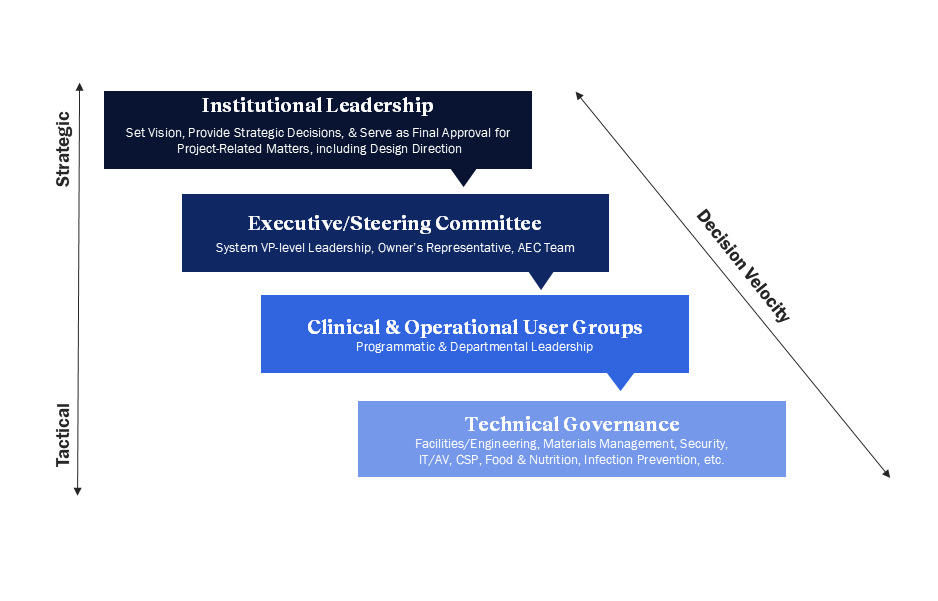
For large healthcare capital projects, governance typically operates across multiple levels, including:
The structure itself is important—but even more important is clarity around who has the authority to make decisions at each level.
.
Projects often rely heavily on user groups and departmental stakeholders to inform design decisions. While this input is critical, someone must ultimately own the final decision—and the accountability that comes with it.
That responsibility belongs to the Accountable Executive.
Depending on the size and complexity of the organization, there may be:
In many cases, both are necessary.
Local site leadership is particularly important because these leaders understand the operational realities, stakeholder relationships, and day-to-day impacts the project will have on the organization.
The Accountable Executive must be able to evaluate decisions in the context of:
Just as importantly, this individual must have the authority—at the site or system level—to:
Without that authority, governance structures become advisory rather than actionable.
When authority is diluted across large committees or unclear reporting structures, decision-making slows and projects lose momentum. In contrast, when governance clearly defines decision rights and empowers accountable leadership, project teams can move with greater speed, clarity, and confidence.
Every major capital project encounters difficult trade-offs. For example:
In each situation:
The speed and consistency of these decisions have real-world implications on project execution.
Design and construction teams cannot progress efficiently when direction changes repeatedly or approvals stall. Delayed decisions can impact:
Strong governance provides a framework for making these decisions consistently and at the appropriate level.
Consider a project nearing completion. Within 12 months of opening, department leaders and prominent physicians approach the CEO requesting significant changes to the facility.
The CEO understands both the requests and the reasoning behind them. However, after carefully assessing the potential impact on the project schedule, budget, and clinical operations, the CEO decides not to move forward with the proposed changes. Implementing major modifications at this late stage would substantially delay project completion, exceed the approved budget, disrupt the planned transition and activation schedule, and hinder the effective operationalization of the facility. Additionally, the delays could slow the organization's speed to market and potentially result in a loss of market share.
That is governance in action:
Another common example involves budget management during construction.
Imagine a project encountering a $10 million cost overrun. Someone must have both authority and accountability to:
Conversely, if the project realizes $10 million in savings, leadership must decide whether to:
These decisions cannot remain unresolved or circulate endlessly through committees. They require accountable leadership with the authority to act.
Even well-intentioned projects can struggle when governance is not clearly defined or consistently followed.
Common breakdowns include:
These issues create confusion for the project team and reduce confidence in both schedule and budget forecasting.
The result is often a project environment where:
Strong governance minimizes these risks by creating consistency in both process and leadership.
As you plan your next major capital project, consider the following:
With governance clearly established, project teams have the necessary structure to operate efficiently and collaboratively.
Every project team wants success. Large capital projects shape careers, reputations, organizations, and communities, and help develop emerging talent into the next generation of institutional leaders.
Strong governance—anchored by the Owner and reinforced by clear accountability—is one of the most important determinants of success on a large healthcare capital project.
When governance is clearly defined:
Healthcare organizations invest tremendous resources into planning, design, and construction expertise. Those investments are critical.
But without the governance structure to support timely, consistent, and accountable decision-making, even the best teams can struggle to deliver successful outcomes.